We come to the final step in the process. This step, if not taken, will put stress on all the other steps. But if taken, the implications have no limits.
It’s all got to do with expansion.
We have seen that we want to start church small rather than big. But does that entail that you continue to be small? No.
The church must expand.
But we now have 2 major problems :
Problem 1 : Empire

This is where the church begins small and continues to increase in size to the point where the church becomes a large gathering. The result then is that the church stops functioning like a Wide Margin Church and starts adopting the practices of an Institutional Church. Sometimes expansion can actually be subtraction. People become a crowd. Discipleship fizzles out. Evangelism starts to become the only thing that matters. We want to avoid that.
Problem 2 : Holy Huddle

The church, in the pursuit of staying small, puts the limit of their gathering at, say, 15. They continue to reap the benefits of all 6 steps of being a Wide Margin Church, but they will never expand beyond that. They persist in a Holy Huddle and put no thought into evangelism or expansion in any sense. They become a walled off garden to a world that needs flowers.
Both strategies have their pitfalls. The first seems strong in evangelism. It can continue to add more and more people to the gathering. But then it would struggle to adopt all the fruit of the smaller gathering. The second seems to retain all that fruit. But then the idea of evangelism or inviting someone is non existent.

How can a church retain community, discipleship and participation whilst evangelizing and growing in number? The answer is not addition. That leads to empires. The answer is not isolation. That leads to holy huddles.
The key is to try and become big and small at the same time.
How do we do that?
Step 7 :
From Adding
to Multiplying

Everyone wants multiplication rather than addition. The problem is that the way that multiplication works is contrary to how many institutional churches work. They will find real multiplication hard to do whilst continuing to adopt the style of church they want.
Addition is not problem for churches. But multiplication will take much resources, dollars, planning, and time.
But what you will see, with a Wide Margin Church that is implementing the first six steps, multiplication is a real possibility.
Below are 7 points that explain what happens if a church promotes real multiplication in their gatherings.
1. To Multiply, You Divide
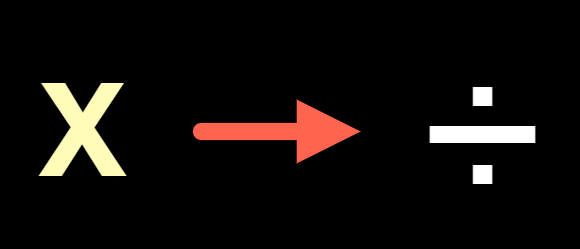

Let’s say your Wide Margin Church grew to 18 people. The way to multiply is not to double the number of people to 36. If you did that, you would lose the other steps. It would become harder to get to know people, harder to participate, harder to manage and harder to disciple. The key to multiplication is actually counter intuitive.
It is to go smaller. Not bigger.
The strength of a Wide Margin church is its smallness. So, if it does grow to 18, scaling it back to 9 people is the key. You divide the group into two independent gatherings of 9. This keeps the good stuff of community and discipleship, but also giving each gathering room to grow back up to 18 again.
To multiply, you divide.
Now an Institutional Church will struggle to do this. They could go from 100 to 200 people by splitting it into two services of 100. But things like space restrictions, resources, time, and complexity will catch up to them making multiplication increasingly harder. So the key is to split the Wide Margin Church into 2 groups. 2 Churches. 2 independent, networked churches of 9 people. One group would stay in the home they are in, and another would meet in another person’s home.
On the surface, this does not look like multiplication.
It looks like subtraction.
18 has gone to 9. But in fact, it’s the same amount of people. It is division rather than subtraction. The true fact is that there used to be one gathering of 18 people. But now there are 2 gatherings of 9. Multiplication of church groups has indeed happened.
What also is cool is that, if in the past, this Wide Margin Church went from 9 people to 18 people, they could do that same process again. The only difference is that there are now 2 churches of 9 growing to 18 people. Both groups could potentially grow to 18 again making the total number of both groups at 36 people.
How did they multiply from 18 to 36? They multiplied by division.
Again, the church could divide into 9 people making it now 4 groups of 9 and the whole process begins again. Multiplication happens through Division.
One of the main reasons that division is so easy to do in a Wide Margin Church compared to an Institutional Church is that a new location for each group to meet is simply going to another person’s place. Multiplying gatherings whilst keeping one location will have its breaking point of space, dollars, leaders, and complexity.
2. Dividing Churches Multiplies Churches
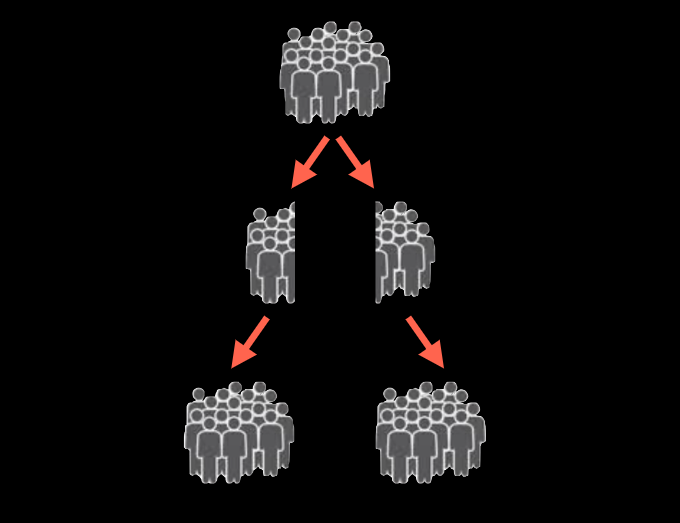

Straight away the Wide Margin Church multiplies from 1 church to 2 churches. You divide again and you multiply to 4 churches. So, dividing churches actually multiplies churches. What this leads to, if multiplication continues, is a cluster of little independent networked churches spread across the town.
Here’s the question I would ask my Institutional Church friends: Are they interested in more people being part of church? Or are they interested in more churches?
Which is better? Say you had 2 churches of 100 people. You only have 2 gatherings, but you have 200 people. Let’s say for this to go to 3 churches of 100 people, they would need both churches to gain 50 more people each. Then at 300 people they can now go to 3 churches of 100.
But what if you had another place that had 200 people part of church, but it was spread over 20 churches of 10 people? It is the same amount of people, but you have 10 times the number of churches. Now some may say that 10 people is not really church, but more like a Bible Study. But again, are they interested in people going to church or interested in more churches?
Those 20 churches of 10 people, if they wanted to grow to 300 total people, each church would need only 5 more people. So multiplication of churches through division is a faster and easier way to get more churches and in fact, more people in churches. So whichever answer they give, whether it is more people coming to church, or more churches, the Wide Margin Church can do both better.
3. Everything Multiplies

It’s not just the number of churches and people that would multiply. Every expression of what that church does will multiply. Here’s a few things:
Locations
Through the Halls to Home step, the church can be located infinitely through the many houses that each person has. At the drop of a hat, the Wide Margin Church can go from 1 church in 1 house, to 8 churches in 8 houses. A continued multiplication will make this expression of church everywhere.
Dialogues
You now have more chatting and more connecting multiplied. Because these churches are not heavily invested in sermons, dialoguing for anyone will become easier and exponentially increase.
Times
If you have one gathering, it can only happen in one time slot at a time. With multiple gatherings you can have them at different times, different days. You could have different locations at the same time or the same location at different times. It gives the church a greater ability to cater to someone joining as there are more time slots. As previously said, the Institutional Church, at best, could have 4 or 5 different time slots across Sunday or possibly Saturday. After that, they would have to invest in a whole new building. This is expensive and time consuming, which then slows down multiplication.
Elders
They are there to manage and looks after the churches. If every church of 10 had 2 elders, in a group of 300 total people you would have 60 elders. Division of churches would multiply the pool of elders. In an Institutional Church the people may increase but the elders not as much, putting strain on people being discipled.
Evangelism
Just by sheer division and spreading of location and times, the body of the church will have more evangelistic traits to it. Just like a cold or trend, a network of churches that multiplies will eventually come to the life of the person. In other words, if the church divides to multiply, then evangelism itself will have its multiplying effect.
One person reaching one other person will make the whole network double in its size instantly.
And there will always be room for new people to be connected as a group can always divide at any one time and form two groups.
Good Works
If every group focused on a particular ministry for the neighborhood, generally good works has a much greater footprint than if it were just coming from one large church. Groups can locally express and cater for the culture around them. If there were a whole network of Wide Margin Churches doing this, the good that this could do for the city and the suburbs would be undeniable. Much of the giving of a church is tied up in the upkeep of buildings and staff. But with a home-based laity-led movement, there is more ability to give and make a real difference.
4. To Multiply, You Subtract


This is where we need to change the course a bit. On one level, getting a person to come is easy. Growing from 6 people to 18 people, if one worked at it, shouldn’t be too hard. But our goal is not to multiply numbers. We actually want to multiply “disciples”. There is a difference. As you know, this process is actually one that is harder and longer to do.
Now there’s many churches that could have an amazing multiplying effect happening. But it does not follow that all people are knowing the Gospel properly. On the outside it looks like a success.
People are joining and multiplying. But quantity isn’t enough. We want quality.
So, this will slow down the multiplication process a bit. Having said that, a church that is strategic in how they divide and multiply will still be one that will rapidly grow.
But we must add this element of Subtraction. Not all people are helpful to have in a Wide Margin Church. Every church, if they actually value discipleship, evangelism, and real growth, must have a filtering process.
Here are 5 types of people that could kill a Wide Margin Church that exponentially grows.
Mr Missing in Action :
He hardly comes

If they are absent all the time, or have a “short” view of church, or just not committed, then the Wide Margin Church is not for them. They are always welcome to come, but they are not the sort of person that will invite another in. Letting this person know first up about commitment would be good. The Wide Margin Church is looking for committed people that show up. Again, if you have 20 people like this, the gathering is not going to invite, divide, or grow at all.
Mrs Statue :
She comes but doesn’t participate

They regularly come, which is good. But they just watch. They consume. The goal is for all to participate, which is the best thing for them. It’s understandable that there are many people that assume that going to church is enough. The Institutional Church, for many, is like this. You regularly come and just watch. Even if one wanted to participate in that setting it can be difficult to achieve. In a Wide Margin Church participation should be easy and inviting. Again, if a large part of your group is like this, this sort of group will not multiply and make disciples. They will not participate well in evangelism or when the group needs to split in order to grow.
Again, when they are invited, you let the person know what is required of them. If they continue to not bring anything to the gathering, allow that person to be part of an Instiutional Church where they can be passive. A subtraction here will help multiplication in the future.
Mr Closed :
He doesn’t want new people

In the Wide Margin Church there should be this understanding that each person should try to reach one new person a year. There may be a particular person that is not interested in any sort of numerical growth. Some, due to the tightness of the gathering, may fall in love with this “Holy Huddle” idea. Adding anyone new may disrupt this sort of community. Therefore there is a temptation to just keep the group as it is. As “holy” as this sounds, the reality is that if you have a group filled with this sort of person, multiplication or any sort of growth will not happen.
So when someone is to join, there needs to be that understanding that the group wants to keep inviting new people and continue to multiply through making more groups. We are not expecting someone to invite heaps of people. Just each one to reach one each year or two years. Even if that were a goal the multiplication factor would reap huge results.
Mrs Takeover :
She wants to dominate

You will come across a person who wants to be a big fish. If they are the only person participating, then they will actually stop others inviting people. It may even be the case that some people leave because the situation is similar to an Institutional Church.
Even in a group of 10 people, you can have a situation where the church functions similarly to a regular church where a person dominates, preaches, and decides on everything the group does.
One of the reasons why this person is not helpful for the gathering is because when the gathering would indeed split and form another group, this individual would rather keep everyone together and build a little empire for a bigger platform. Inevitably these sort of people will kill all the benefits of the Wide Margin Church and make it into any sort of Institutional Church.
So this person needs to know what’s required of a Wide Margin Church. The goal is to split and multiply through smaller gatherings on the back of a diet of dialogues and laity-led ministry. Sermons could be something utilized but it should not be the norm. It is common for this sort of person to not like this structure of church and move on.
As with all of these types of people, we are giving examples of subtracting people for multiplication. In the long haul, churches that do not promote these people will make discipleship stronger, breed more elders and independence for each church and make division happen in a smoother way.
Mr Stay :
He doesn’t want to split

The way that the Wide Margin Church grows is through division. A general idea would be : When you get to 20 people, you divide into 2 groups of 10 people. There doesn’t have to be a magic number. It can be up to the group. The idea is to make sure participation, and discipleship is possible with a tight knit group.
There will be a sort of person, Mr Stay, who will be against splits and divisions. This may result in two ways. Either the group just stays at 20 people forming a nicer form of a Holy Huddle. It’s not that they are against inviting people, but the love and community they have experienced is so great they just want to keep it as it is. Or the alternative is that whenever someone new comes, instead of splitting, the group continues to grow beyond 20 to 30 or 40, with the result being that they are now forced to institutionalize the church to keep all of it together. They are against splitting and would rather keep all together and change the fabric of the church rather than split.
Division is part of Multiplication for the Wide Margin Church. If you don’t divide, then it’ll just be Addition.
But Addition leads to Subtraction in the long haul. Subtraction of dialogues. Subtraction of participation. Subtraction of places to meet. Subtraction of elders.
So, from the beginning, anyone joining the church needs to understand the concept of multiplying through division.
We are after the type of soil that produces fruit that will last.
5. New People Go From Something to Something rather than Nothing to Something
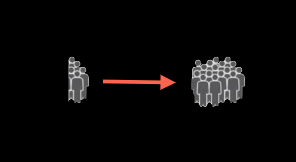

This is a crucial step in the multiplication process. When we do invite someone in, ideally that person has already connected to some in the gathering. They may even understand the philosophy of the Wide Margin Church and so, when they do come in, they are not starting from base zero.
You can invite someone from base zero, say, a stranger. This could make growth happen easily. But this sort of strategy, in the long run, may not tend towards multiplication through division.
So a better way is to think of bringing someone into the group after they have connected in some sort of “side gathering”. Here are a few examples of someone going from something to something:
A one-on one ministry
You could be meeting up with this person regularly discipling them and connecting with them. They could be a Christian or a Non Christian. This could be just praying with them or fellowshipping with them. If they do become a Christian through this process or are more on board with the Wide Margin Church idea, they could then be brought into the group. They already have a known connection with you and possibly others and are somewhat on board with the philosophy of the small gathering.
A Discovery Based Study group
There could be a little ministry that one of you people is doing where they are meeting up with another person or even a group of people doing what’s called a DBS. The group would be regularly looking at a passage in the Bible and discussing about it. Through this sort of gathering, a person could then want to be part of the Wide Margin Church gathering. What they will find is that many of the elements they enjoyed in this DBS group would be there in this church gathering. So, the person would be going from something to something of similar practices. A Wide Margin Church doesn’t need to do DBS style teaching, but many will due to the participating nature of it. Therefore, a Non Christian who learns about Jesus in this setting would enjoy a church gathering that keeps this sort of footprint.
There are many other examples we could put here, but the point is that relationships have been made and that a person, if they were to join a Wide Margin Church, are going from something to something. Problems arise when the person or a stranger comes right into the group. It could work, but the goal, again, is not just multiplication of numbers but multiplication of disciples.
People who have been exposed relationally to someone in the group and has had a time of participating and getting to know the Scriptures, is more likely to be a disciple that will be on board with the Wide Margin Church philosophy.
So this approach is not an example of what is called “extractionism”. Rather, the new person has been connected previously and if they do participate in the life of the church, will be exposed to practices that they have had some exposure to already. Compared to a traditional church, a stranger being plopped into that service will find it very strange and extractional.
Another benefit of approaching multiplication through this method of a “side gathering” is that people will find out whether they are right for a Wide Margin Church. This is a great filtering process for any person that does not align with the philosophy of the group. So if someone does come into the gathering, then the gathering can do what it needs to do, which is to build up the body of Christ and make stronger disciples.
Another important point is that with these “side gatherings” the goal is to go where the person is at. It is to be evangelistic in its nature. It is a missional field.
Problems arise when church gatherings just become a mission field for gaining converts. Let those things happen but let them happen “outside the church”. We want really Christian body life to happen inside the church.
Again, this filtering process will likely mean that if someone does join, they are on board to becoming a disciple rather than a non-participating nonbeliever.
The point is that the church needs to be in the business of selection. Not all people are fit for the Wide Margin Church. If the goal is to really disciple and multiply well, there needs to be a system in place that best promotes that. Getting new people to go from something to something is a good filtering and exposing process for that.
6. There’s a Place for Large Gatherings
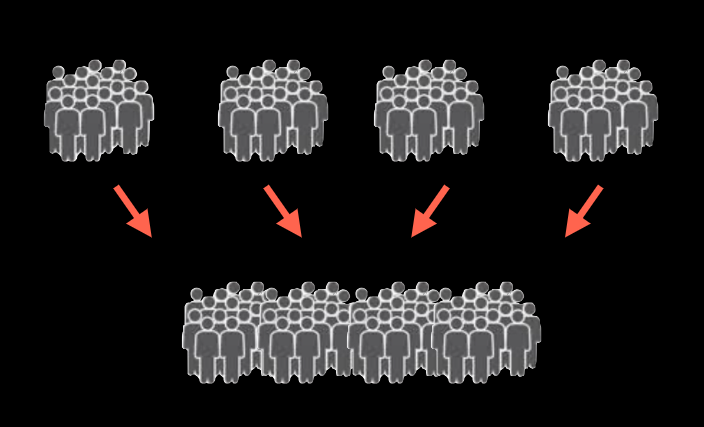

Many churches will have 2 types of gatherings: A Large gathering, and a Bible Study gathering. The large is the major more important one, and the smaller is the is the minor or the “add-on”. If a person were to have just one gathering, it would be the first one.
I believe that this sort of idea should be flipped around.
We should make the smaller gathering the major one and make a larger gathering as an “add-on”. I am not against larger gatherings. There’s a place for it. But it should not be the primary gathering. I will explain what this may look like.
Say you have a group of 20 people. They decide to split off into 2 churches of 10 people. That does not mean they cannot be “networked” in some sense. As previously mentioned in the step about “Decentralization”, I believe each gathering would be a church in themselves, run by the group, rather than being under another, or a clergy group straddling both. But there still could be networking, coaching, mentoring, and pastoring to help out both gatherings.
Occasionally there could be an event where both gatherings come together, say, as a gathering of 40 people. This could be an Easter event or a Training Day, or even a weekend getaway that may have a few sermons. The point is to keep this as a minor thing rather than the main thing. The goal to multiplying is not through the large gathering but through the small Wide Margin Church gathering.
Having said that, there is nothing wrong with combining with another gathering or even multiple gatherings in order to reap the benefits of mentoring, fellowship, prayer, and extra training.
7. Have Micro Gatherings to Multiply Main Gatherings
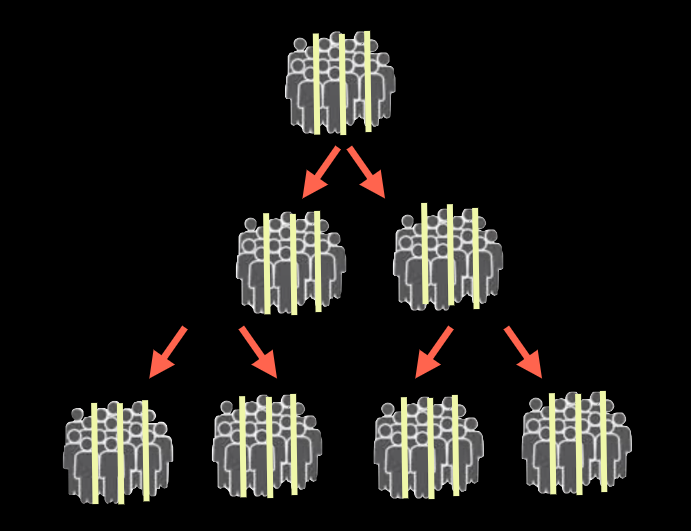

One idea that can help with discipleship and multiplication is to think of even smaller gatherings inside the main Wide Margin Church gathering, which I call “Micro Gatherings”.
Say you have a church of 9 people. This could then be split into 3 micro gatherings of 3 people. There is no hard and fast rule, but a micro gathering should be at least 2 people to about 4 people at the most. They would be groups of the same gender that would pray and care for each other on an even deeper level. These micro gatherings would be more of an intimate group.
The truth is, even in a smaller gathering of, say 10 people, some things shared may not be helpful.
This would be the strength of getting everyone in the group to be part of a micro gathering that meet on their own terms.
Connecting with point 5 of this article, new people could go into a micro gathering as their first port of call. Or even better, when the new person is part of this gathering, it may not be dissimilar to the gathering they experienced previously outside the church. This would just have a more Christian intimate feel to it.
So the idea is that when the Wide Margin gathering increases number, the micro gatherings would multiply too. For example, if you were a gathering of 8 people, you could have 2 micro gatherings of 4 people. When that 9th person comes, the group could then be comprised of 3 micro gatherings of 3 people. Even if the main gathering split at 18 people, you could still have the same micro gatherings continue into the new church of 9 people each.
There is no hard and fast rule in how many people to have in a micro gathering. But I think 3 is the ideal number. 4 starts to feel like a crowd and 2 would have the potential of not happening as much if someone is away. 3 is the beginning of true community that is tight knit.
Again, these groups will be a subset of the main gathering of 18 people or so. So the church member will get the experience of a larger gathering where they can still participate and also gain the experience of a micro gathering where things like prayer, discipleship, and mentoring can happen on a greater level.
It is possible to have someone who is only part of the main gathering and not a micro gathering. Vice versa, there could be someone that is only part of a micro gathering rather than the main gathering. That is fine. Ideally we would like someone to be part of both. If someone is keen on multiplying and discipling, I think, being part of a Wide Margin Church, comprised of a main gathering and many micro gatherings, is the best way to promote love and fellowship and real growth in the church
So there’s a few ideas about multiplying rather than adding. The Wide Margin Church needs to be in the habit of thinking to multiply. Too many small churches are not thinking like this.
What It Could Look Like
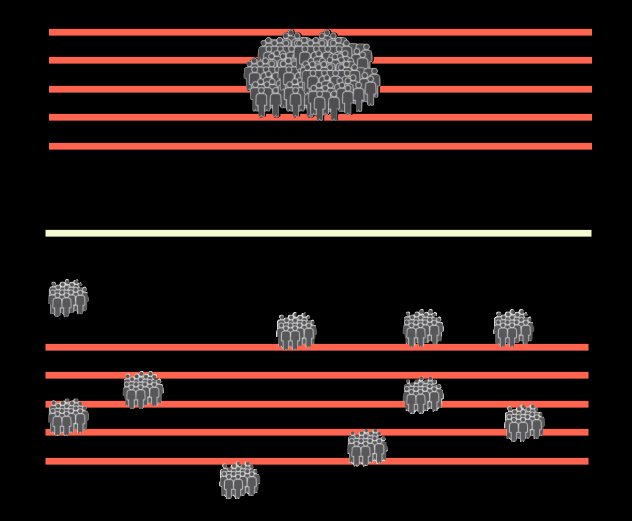
If multiplication is done well, here is the multiplying effect of a healthy wide margin church adopting all 7 steps, compared to a successful institutional church plant that begins with 50 and adds 200 people each year.
| Years | IC/WM | Effect |
| 1 | 50/5 | IC 50 in hall. WM in a home. |
| 2 | 250/10 | IC one service in hall. WM in home. |
| 3 | 450/20 | IC must split into 2 services. WM could still be in one location in a home. |
| 4 | 650/40 | IC now must think of 2 locations. WM will now split into 2 locations of 2 churches. |
| 5 | 850/80 | IC 2 full locations and services. WM in 4 locations. After 5 years it still looks like the IC strategy of growth is way more effective. But WM is actually in 4 areas now. |
| 6 | 1050/160 | Complexity kicks in for IC to hold over 1000. Multiple locations and dollars and pastors. WM goes to 8 locations of 8 independent churches in 8 homes. They now have the ability to create one large service if wanted. |
| 7 | 1250/320 | IC starts to run about the same as percentage of growth not as much. WM goes to 16 churches in 16 locations. |
| 8 | 1450/640 | IC in multiple locations becoming a very large church. WM, for the first time, has added more people this year than IC. 32 locations becoming the beginning of a viral movement. |
| 9 | 1650/1280 | IC, at this point, each year could be seen as similar as growth percentage has slowed down. WM is now over 1000 with 64 locations. They have the ability to now function as a mega church movement with multiple large gatherings if desired. Their growth of 640 people is triple the growth of IC of 200 for that year. |
| 10 | 1850/2560 | The WM is now comprised of a lot more people than the IC. This is even just after 10 years of implementing growth through division and multiplication. The WM is now across 128 homes. It is at this point that the movement will make huge head waves. |
| 11 | 2050/5120 | By year 11 it can be shown that the WM strategy is a faster, easier, and cheaper way of growing the church. Here, in the space of 11 years, WM has doubled the amount of people. Across 256 locations, this is no problem to make this movement work. You just need 256 homes of 20 people. |
As one can see, the growth is undeniable. We even granted this institutional church to grow 200 people each year, which is very generous. But even if they managed to grow more than this, the wide margin way will eventually catch up to them. Even if the wide margin church multiplied at half the speed, eventually, by 20 years or so, it will double the institutional church model.
If there are church planters or church growth experts out there, you must have a look at these numbers. The quickest way to multiply is through small churches that constantly split into new small churches. The problem is the institutional church is not built for actual real world changing growth.
Let’s say every person at your church invited one person for next week’s service. Could you hold them all? Possibly. Say those new people invite another friend and everyone else invites another person too. Could you hold the all? Already, many churches would struggle to cater for this. They wouldn’t have the chairs or the space or the administration ability to deal with it. And this is after 2 weeks! The problem is obvious. The central way of doing church has limitations of space, locations, leadership, money, and community.
But think about the Wide Margin church way. If everyone invited another, could you do it? Yes. Even if everyone invited people again, the gathering, at the drop of a hat, can meet in 2 homes or 4 homes. It is cheap and easy to cater for a real widespread growth of people wanting to come to church. Due to it being laity led rather than clergy led, the problem of pastors and leaders is a chance for all people to step up and lead each other.
The multiplication effect on the institutional church will crush it. Soon enough the pastor will dislike church growth and try to be keep things the same.
So maybe, in God’s grace, revival hasn’t happened. Why? Because the churches are not equipped for it. In fact, the churches are not reaching for it. Maybe God is waiting for a Wide Margin Church movement that can actually care and cater and disciple a large amount of people coming in.
As we have outlined, a Wide Margin Church should try to adopt these 7 steps. If done properly, by God’s grace, the landscape of what “church” is will completely change.
Are you ready for a real movement?
Are you ready for something to be done on the margins rather than the centre?