The church needs to realise that the Western world has dramatically shifted. It has gone from a Central Culture to a Wide Margin Culture. This means that the way we do church is not the best and most missional, biblical, and disciple-making way of doing church. We have looked at 4 steps in becoming a Wide Margin Church. In this and the next session we will deal with step 5, which will be another drastic change.
We will be zooming into the idea of teaching and discipling. Because we have abolished the idea of the clergy, we are left with another problem. People inevitably ask this next question :
“If you don’t have Clergy or a Bishop or Ordained Priests, then who is going to preach?”
It’s this thing called “preaching” that is a major part of church. And it has actually got caught up in the way and style that we have done church for over 1000 years.
So let’s have a closer look at what exactly is “preaching” and then show an alternative way that makes more sense of the way that the world is run today.
First we will give a basic outline of what most people think of when they think of “preaching”
Preaching is Teaching
It is a spot in the service where teaching happens. It can vary from a few minutes to even a couple of hours. It’s a time where everyone teaching happen through the act of preaching. It is viewed by many as the most important element of the service, because this is the time where God primarily communicates to us through the preaching.
Preaching is Monological
Generally preaching is done coming from one person. It is a monologue. The person preaching is talking to you, or lecturing. There may be some smatterings of dialoguing with the audience, or some questions, but primarily it is monological in nature.
Preaching is Exegeting
The point of preaching is to exegete, to expound the Scriptures. It will preach a text from the Bible with everyone listening and understanding the passage better. The point of preaching is that it is to be Biblical in its content. It is not just a time of chatting or talking about anything. You are to exegete the Bible.
One of the uphill battles with preaching is due to its monological style. People struggle to listen to one person for a long time.
Increasingly preachers will add more illustrations and stories into their preaching to help retain the attention of the audience. Some preachers may actually give little to no Scripture and mostly talk about Self-Help information. All of this, I believe, is due to monological exegetical preaching being hard to listen to, hence the preachers try to add some entertainment into it.
Well, how did this act of “preaching” happen in the church? Here’s a few reasons:
Clergy were seen as Gatekeepers to the truth
A certain amount of people were seen as knowledgeable in the church and increasingly all forms of “teaching” started to funnel through them. They were the gatekeepers to understanding the Bible, which started to be done through the practice of preaching.
Laity were uneducated and without access to the Scriptures
It has only been the last 100 years where most people have the ability to read and write. Back in the early church only a select few could do that. Also, the Scriptures were not something that everyone had. Therefore, it made more sense for the educated clergy to exegete the Scriptures for the rest. The Bible was seen as a difficult dangerous book, so they were all needed to be taught from it properly.
Preaching arose due to the Clergy/Laity split, making it a more pragmatic way of teaching to a larger group

Because of the lack of knowledge and accessibility, people would flock into larger groups, excacerbating the need of “preaching” to happen. A teaching that was monological in nature made more sense. One preacher could teach 100 people at once. So the size of gatherings tilted to the practice of preaching.
So in summary, preaching made more sense in that cultural setting. It was more of a central culture where people obeyed and listened. They saw the priest as the direct mouth of God. It was like Mount Sinai listening to God through the preacher. It was your main diet of understanding the Scripture.
So that may explain why preaching became prevalent in the body of the church service.
Before we look at an alternative to preaching, there’s a few more preliminary points that need to be made.
1. Preaching is not a Biblical Mandate
Some may say that preaching has to happen in a church gathering. If there is no sermon, then there is no church present. But nowhere in the Bible does it say that someone has to give a “sermon” whenever you meet. We have just gotten use to thinking that that’s what a church service must have.
Now preaching sermons can be very helpful. It can be pragmatic and practical. But it’s not a Biblical mandate.
2. Preaching is one way of Teaching

Some may push back and think that if a church gathering does not have preaching, then there is no teaching. They have confused the two. Preaching is teaching but teaching is not only preaching. There are other ways of teaching.
This actually can cloud our way of reading the Bible because when we see passages that say “teach the people”, we think, “preach at the people”.
But we are to “teach one another”. That does not make sense with the modern way of preaching monologically. So there are other forms of teaching that a church can adopt. Preaching is only just one of the ways.
3. Preaching still has a place
Neither hear me say that preaching is wrong and shouldn’t be done. We should swing too far and say “preaching is the only way” or say “preaching is avoided”. There is a place for it.
But I will say this : Preaching shouldn’t be the primary way of teaching. It has its place, but don’t make it the jewel of church.
Think of it like a goal celebration. A local sports team scores a goal and then the team does a little dance together celebrating it. But the bulk of their energies and time has gone into the fundamentals of the game : running, passing, shooting, defending. There’s a place for goal celebrations, but that should not be the primary thing a team focusing all their energy on.
Much like a church, preaching has its place, but other forms of teaching have more value in building up the body of Christ.
4. Preaching is Reaching rather than Teaching

Here’s the interesting thing. The Bible does talk about preaching but it’s not in the way that you think. Primarily it was done “outside the church”. Preaching was envangelising. Calling out the Good News to people. Much of the Book of Acts has preaching, but it’s done to the non-believer rather than the believer. Yes, it is a form of teaching but it was more about “reaching”, getting people to convert. Warning them.
And then, when people did respond to the preaching, the early church would set them up as a church gathering, which would then have various other styles of teaching rather than preaching. Why not preaching? Because preaching was more about reaching than teaching. These people have been preached to already, and they have been “reached”, and now they must be “taught”, which did not require preaching.
Now this is a big problem for the modern-day church because we are doing the opposite of this practice. We are even muddling up what preaching was supposed to do and who it was primarily for.
We are doing “preaching” inside the church,
rather than outside.
Even more than that, our “preaching” is more “teaching” than “reaching”. Some churches do see the sermon as a big evangelistic gospel call, but the majority are teaching to the believers in a preaching way.
5. Preaching isn’t Monological

Again, this is another mistake that we have made. When we hear the word “preach” we think of one person talking all the time in a monological way. Rather, the word in the Bible is more dialogical in its nature. Preaching had a more dynamic approach. It was not just you speaking but it was you asking questions, taking questions, getting responses from others, discussing with people.
We see snippets of this in the ministry of Jesus. He would “preach” in response to a question someone had. He would push back on someone’s question, he would see what they thought. Yes there were forms of Jesus talking a lot and giving stories, but it has some dialogue aspects to it. It was more of a back-and-forth way of teaching
As I said previously, “preaching” was more about “reaching”. You were trying to win the person over. Part of that is listening to them, getting their attention, seeing if they understand what you are saying. Preaching was not primarily monological.
So when you see the word “preaching” don’t default to a picture of one guy talking monologically. It may be that at times, but mostly it was not. Even when Paul reasoned in the Hall of Tyrannus for 2 years, it was probably not monological sermons. Or even when Paul was in the upper room talking to the church and the poor lad fell out the window. We are assuming that Paul is the only one talking all the time. It was probably more the case that he was talking and answering questions from people and prolonging the night in that way.
So, with all that in mind, how does “teaching” work in a Wide Margin Church? What works well in the cultural field that we are in?
What is a way of doing teaching that is both “missional” and “biblical”?
And, most importantly, if we are to make disciples, what way of teaching in church promotes that the best?
Here’s the thing : Teaching must happen in the church. It’s not a church if teaching is not present. So before someone thinks of a small gathering as just a social “chit-chat” community, we need to make sure that we are promoting a church that is pro-teaching. We all need help. We all are sinners and so we come together to learn.

Secondly, this teaching will be primarily Biblical teaching We are going to be taught by God’s word. There may be smatterings of other teaching types, such as science, psychology, or practical wisdom, but primarily the Scriptures will be our headquarters.
So, with all that in mind, what is this crucial step that will unlock the power of the Wide Margin Church?
Step 5 :
From Monologue Teaching
to Dialogue Teaching
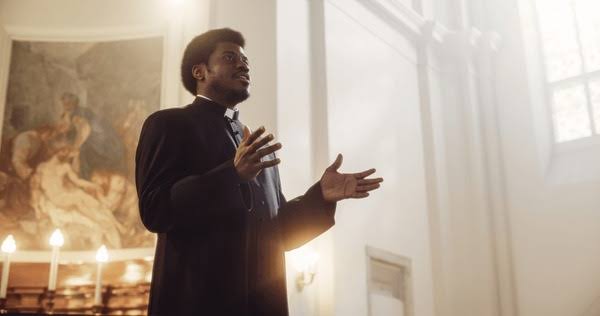
Monologue is this idea of teaching coming from a select few. The small minority will be the speakers, whilst the majority present will function almost entirely as listeners.
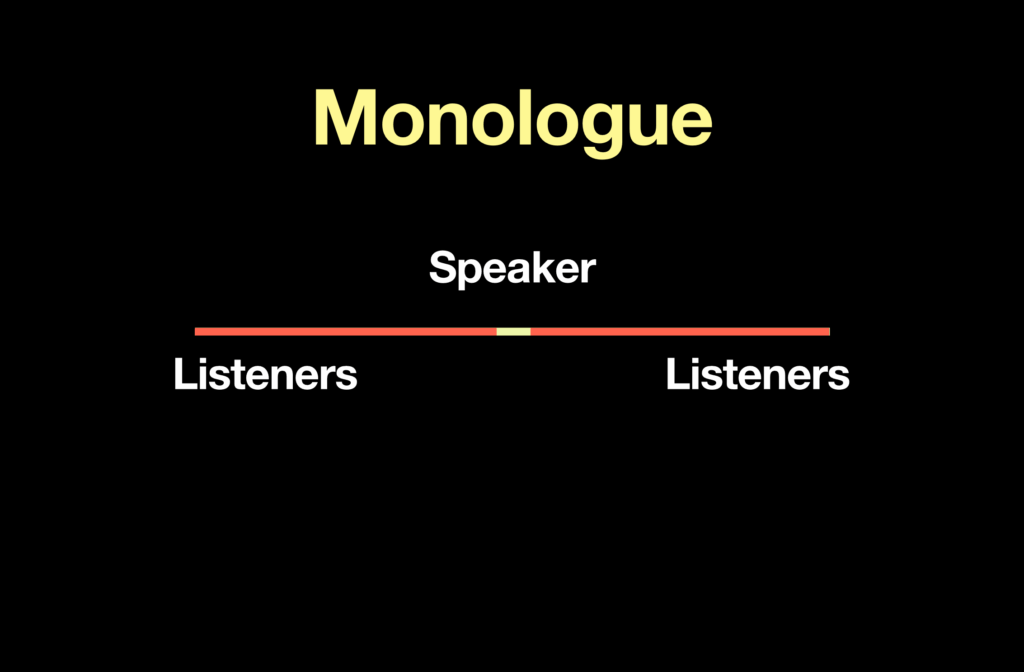
It is a one-way street, hence, monologue. Much like watching a performance on stage, you, the listener, function like an audience. Generally this is done in the sermon. It is an example of a central culture posture, that is, that a small amount in the middle lead and dictate the structure and style of what church is.
But Dialogue is the idea that teaching comes from all people. Instead of one designated speaker, everyone present has the ability and the encouragement to join into the teaching and speaking experience.
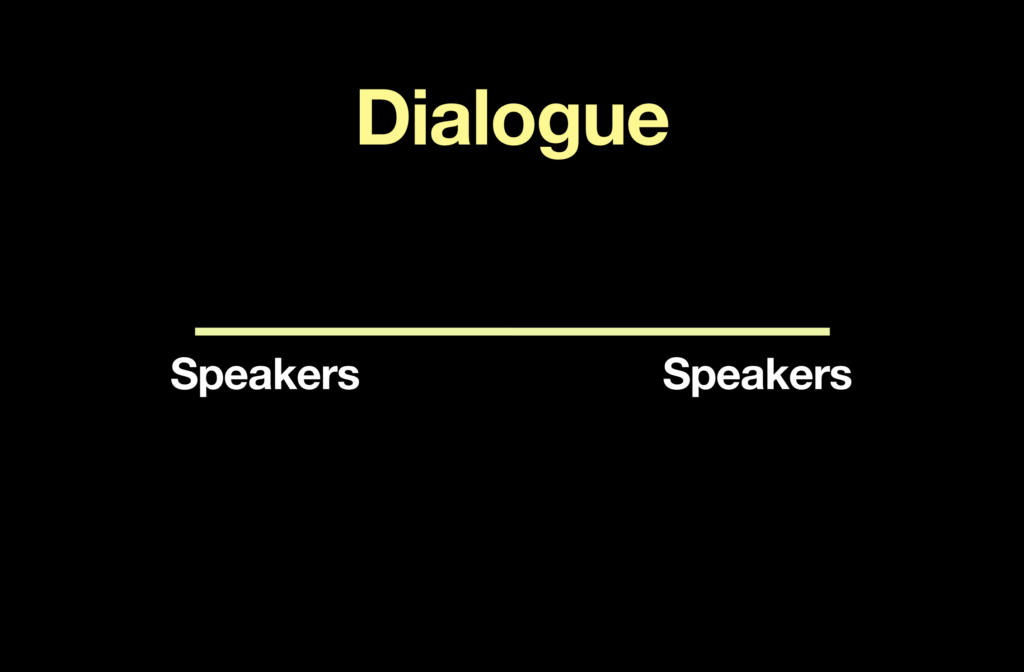
This means that teaching comes from a wide variety of individuals. This does not mean that there are no listeners present, but it does mean that all people present will listen and will be able to speak. Now it is important that this is Step 5, because the previous ones will make this step 5 an easier transition. Here are three ways the previous steps help:
1. There will be less people
A monologue makes more sense when there’s a lot of people. Conversely, dialogue with many hundreds of people would be diabolical. Hence, if your church has fewer than 20, then dialogue makes more sense. People can be heard, everyone could share.
2. Everyone is being trained to lead
If they are doing it properly, then they should already be participating in a laity-led ecosystem, meaning that dialoguing and teaching one another is something that they may be naturally doing already.
3. A house leads to dialogue
The environment of the church, the setting, with couches, smaller groups, is ripe for dialogue rather than monologue. People don’t realise that if they are in a hall with many pews and a stage, even if you wanted to practice dialoguing, the environment around you screams monologue.

So if Steps 1-4 are done properly, you will notice that your church will naturally slide from monological teaching to dialogical teaching.
Now, there are a few things that may look like “dialoguing” when they are not really that.
The Dial of Dialogue
Below are 4 ways of teaching that increasingly are more dialogical, though they still fall short of true dialogical teaching. In saying that, I believe these teaching forms are better than a long sermon.
Mini Monologues

To make the church more “dialogical” and laity-led, some churches may have a variety of speakers. They may have 3 mini sermons, or it could be a service where multiple people come up and share their testimony. This may be better than one sermon, but it is still in the stream of monologue. A variety of people, but in the vein of monologue.
Q & As

After a sermon, or even as the sermon, some churches have a time where people can ask questions from the floor. It is usually just a question, not a monologue. And the answer is usually given by the preacher. It has a taste of dialogue to it, but again, it is monologue because the teaching is still controlled by the preacher. If it did break out in a back-and-forth scenario, people would get upset by that.
Discussion Panels

This would be the next level up. You would get a group of people “dialoguing” on the stage, maybe a group of 3-4. Others are sitting down watching. When they talk, their teaching is in fact, dialogical. I actually think this would be a much better way to do teaching in a big service, rather than a sermon. It has the elements of Q & A, preaching, and a variety of people giving their opinion. But the problem is that it is still viewed by an audience, meaning it is still monological in nature. I call this type also “Dialogue Monologue”.
Controlled Dialogues

This is where you do have a group of people dialoguing without an audience, so much like a Bible Study. But a controlled dialogue would have someone leading all the time, answering the majority of questions and preparing the layout of how the teaching would go. They may be done with a series of questions that are down on a sheet. You can also have a controlled dialogue where someone (an author) has made a devotional or study guide, which controls how the dialogue will go. This could even be done via videos. Now there are some positives in controlled dialogue, in that someone else has done major preparation for the dialogue to be done in an ordered and timely fashion, but it can also kill the spontaneity and direction where the dialogue may naturally want to go.
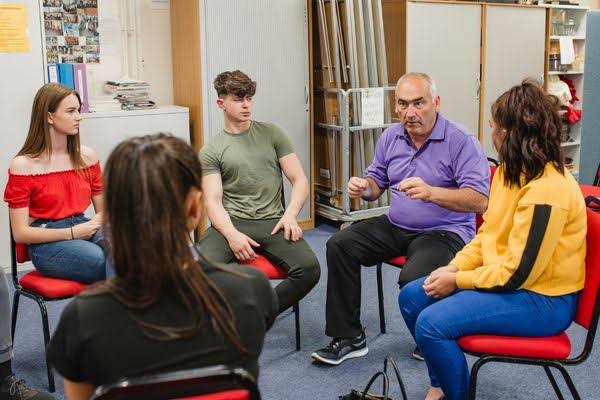
So there are a few versions of “dialogue” that I don’t think go far enough. The major question to ask whether something is dialogical or monological is this :
Can this teaching be done without a particular individual?
If the answer is “no” then it still has monological elements.
With all that, what does Dialogue look like in the Wide Margin Church?
1. The Group Must be Small
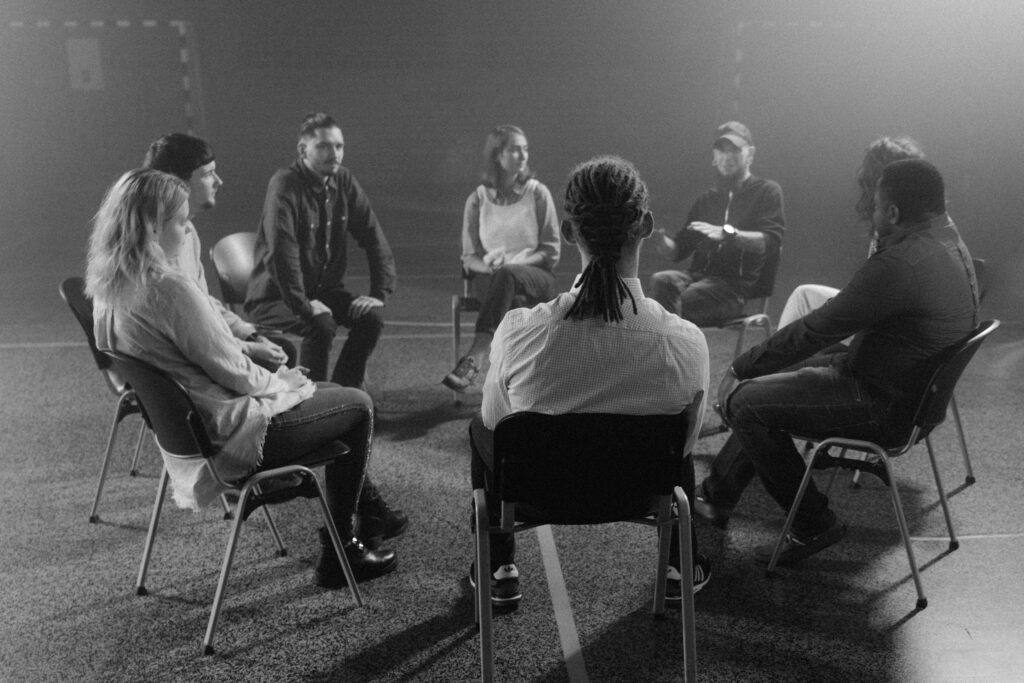
If the gathering exceeds 15 people, it can become increasingly harder to do dialoguing. There will be a tendency for an individual to take the reigns and monologue. So the group needs to be wary of this.
If more people come, the group must divide, in order to keep the teaching experience dialogical.
Now this is the case for anything that is in the gathering. Things like singing, praying, eating, sharing, will all be more difficult to do the larger the group gathers. Keeping it small makes it easier to reproduce, to facilitate, and participate.
2. There must be Dialogical Order

What I mean by this is that it cannot be open-slather dialogue. That is, talking about the weather, about footy, about all sorts of things. Dialoguing is about teaching rather than chatting. There is, in some sense, a controlling factor to the dialogue, searching for a particular goal. It is loose, but there is some form of order.
These may even be things like “time”. The group may agree that the first hour of coming together is for this “teaching”. Others may agree to have it throughout. Some groups may agree to have the dialogue in a particular part of the house, so that when the group gathers at that location, everyone knows that the teaching dialogue will begin.
We want to be a simple church
not a simply chatting church.
But don’t go too “ordered” in this affair. You want to keep the gathered space open for spontaneity and unpredictability.
3. It must be Biblically Saturated
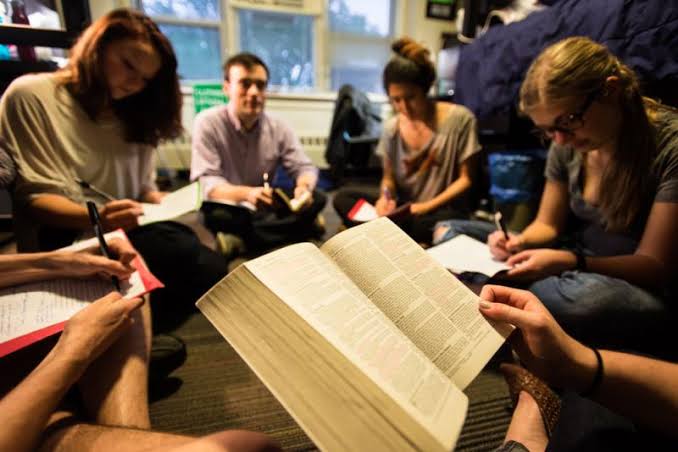
There is no point coming together if the Bible is not talking or discussed. So it must be “biblically dialogical” rather than just “dialogical”. There is a tendency for dialoguing to primarily be people sharing their feelings, and ending up being a chit-chat. Definitely there is a place for people to share how they are going, but it must be in the midst of the Scriptures. The Scriptures are there to help us in our Chrisitan walk. To not talk about the solution but just the problem is to not do Biblical Dialoguing.
It must also be “saturated” with Scripture rather than “sprinkled” with Scripture. Some dialogues may include Scripture, but it is more of a passing nod of the heart. True dialoguing will frequently deal attend to the Scriptures rather than being in the background.
This is not just reading or memorizing it. It is playing with it, meditating on it, singing it, praying by it, sharing our experiences of it.
The point is that when people do leave, they feel that the teaching experience really came from the Bible rather than the head of the Preacher.
4. It must be Group-led, not Individually-led
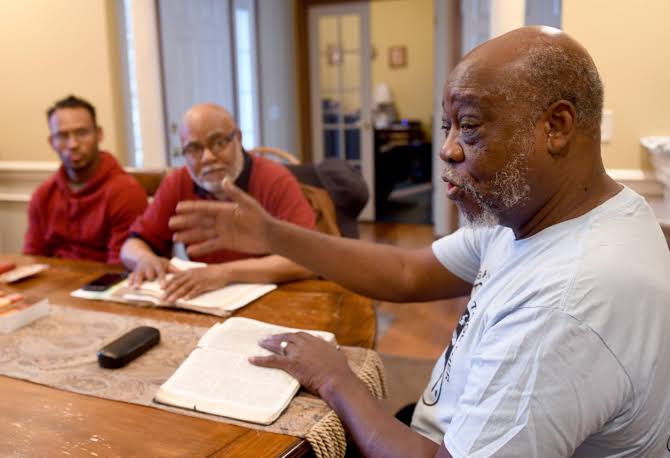
The quickest way to kill a dialogue is for an individual to totally lead the experience. Without realising, your dialogue experience can devolve into one person just giving a bible talk with a few saying a couple of off-hand remarks.
Some people’s personality can just get in the way and become a monologue.
What this does is it trains people that Joe Bloggs will give the answers, so I don’t need to talk, or worse, that if I say something Joe Bloggs will correct me or get annoyed that I’m stealing their thunder.
As I said previously, if your dialogue experience cannot happen if a certain individual is not there, then chances are you were always “individually-led” rather than group-led.
Now group-led does not mean no-led. But it does mean that it needs the type of leading that promotes group dialogue. Below are a few things that can promote group-led dialoguing:
1. Have a Facilitator
This means there is a particular person that manages the dialogue. There are not leading and talking all the time. They facilitate. Much like a referee. They try to keep themselves out from running everything. This can help dialogue because it can put the breaks on any individual that dominates and they also make sure the group stays on track with the Bible. A good dialogue experience is when you don’t not even notice who the facilitator is. They are just there to check and monitor how things are going. Things like knowing the time, watching the dynamics of people, and making sure things are on track is a helpful way for dialoguing to not devolve into chit-chat church.
2. Rotate the Facilitators
Every now and then it would be good to change the facilitators. We don’t want to enforce that everyone facilitates, but we also don’t want the same individual having that role of facilitator all the time. It is tempting for a facilitator to step into preacher-mode and then think that if they do not facilitate, that the group can’t go ahead. You could even swap it after each term.
3. It must be Reproducible
Whatever way you do your dialogue, you must ask if it is something you could produce every time. Is it something that any person could participate in and facilitate by? If it is too complex, this will breed bus drivers and bus riders. We don’t want it to be simplistic but it does need to promote dialoguing. Even things like printing out papers, using technology, making costumes, anything can make it more difficult to keep producing it.
4. Use Discovery-Based Bible Studies
This is a technique where you focus on one passage and ask very simple questions of the text. You try and stick to the passage rather than go all over the place. Everyone may be given a sheet of text where the facilitator asks questions from. The good thing about this is that anyone could facilitate this and anyone can participate in it. Hence, it is reproducible.
Any person, even a Non Christian, could be part of it and even facilitate. And what you’ll see is that the whole teaching experience will be one great group dialogue. Now, you don’t want to box people into a system, but this could be a great way of going through the Scriptures with all participating.
5. Have Shallow Pool and Deep Pool Dialogues

Many may question the Discovery Based Study form because of its simple system. The benefit of it though is that anyone can be part of it, even children. But I do think that there is a place for a deeper type of dialoguing. But don’t do both in the same session.
Think of it like a pool. Discovery Based Studies are shallow, playful, anyone can participate. A deep discussion is a little bit more adventurous, scary, mysterious. I do think there is a place for this but it would happen depending on the group that you’re in.
Again, it must be reproducible and biblical and not vested in one type of individual. But some people do want to go deep and there should be some sort of avenue for that. But I think it must come off the back of Shallow Pool. The man that only wants Deep Pool is the man that is trying to do Individually-led rather than group-led dialogues. We all need to be competent in shallow pool experience. This is our bread-and-butter Christian experience.

But here’s the thing, the Scriptures are deep already. Those people that want this “deeper experience” sometimes it’s not really deep at all.
Sometimes you can go “beyond the pool” and into the Ocean, drifting away into unwanted unbiblical lands.
That’s why I like Discovery Based Studies because it grounds the group in the Scriptures whilst maintaining the freedom for the group to discuss it the way they want.
6. Dialogueize all facets of the meeting

In order for people to get used to dialogue, you should try and implement this diet to all things you do. Here are a few other elements that could be “Dialogueized”.
1. The Singing
Get people to make up songs or choose the songs that they want. Anyone just brings an instrument. You could have a music facilitator that is different for each gathering. Music is an experience that should be dialogical.
2. The Meals
Don’t just get one person to do meals. Everyone pitches in and brings what they can. Also, meals can even be done as a teaching experience as well.
3. The Meeting Space
Share it around at different people’s places. Inside or Outside. Shake it up. Let the group decide.
4. The Sharing and Praying
Encourage all to bring something to the group, to participate. Prayer is something that should be spontaneous.
The point of all that we have discussed it that we want Wide Margin Churches to be a steaming pot of Dialogue.
The more people that participate,
the better the experience.
Now there is a place for a sermon. I will not say sermons cannot be done. But the main diet of the gathering, not just teaching, should be dialogical rather than monological.
People today want to give their opinion. Sadly, too much of their church experience comes on the back of hearing boring lectures. The church needs to be a communal place where the Bible is taught, sung, prayed about and such.
Please give the group the time to do all of that well.
But that just leaves us with the next problem that many people have :
“I thought church was to go for an hour.”
That’s the next step.